indianceramica@gmail.com - GST NO. : 23ASHPA0569P1ZM
- Send Email


Posted by Admin on July, 28, 2026
What Causes Edge Chipping in Ceramics — and How Do Feldspar, Quartz, and Kaolin Prevent It?
The 5 fixes for edge chipping through raw materials:
- Verify sufficient feldspar flux content — under-vitrified bodies are inherently weaker and more prone to edge damage during handling.
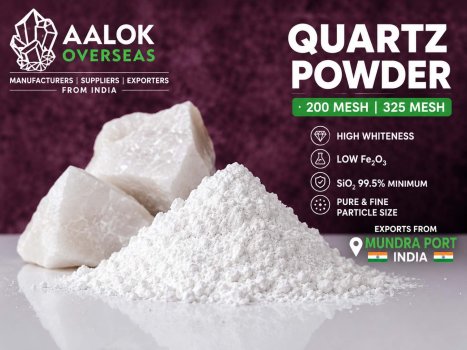
- Control quartz particle size and content — coarse or excess free quartz creates internal stress concentration points that edges are especially vulnerable to.
- Use plasticity-verified kaolin — proper bonding during pressing gives the green (unfired) body the strength to survive handling before it even reaches the kiln.
- Confirm consistent mesh grading — uneven particle size across feldspar and quartz weakens the body's structural uniformity, including at edges.
- Match raw material grade to your MOR target — edge chipping is fundamentally a mechanical strength (MOR) symptom, and raw material selection should be driven by your specific strength specification.
Source: Aalok Overseas Technical Laboratory, Rajasthan, India · Manufacturer & Exporter of Feldspar, Quartz & Kaolin to 50+ Countries Since 1992 · www.feldsparindia.com
Home Potash Feldspar Sodium Feldspar Quartz Powder Kaolin Contact Us
Home › Blog › Edge Chipping in Ceramics
AALOK OVERSEAS INDIA · CERAMIC DEFECT GUIDE
Mechanical Strength · Flux Content · Quartz & Kaolin Balance · NABL COA · Exporter Since 1992
REQUEST HIGH-STRENGTH GRADE SAMPLE → VIEW SPECIFICATIONSWhy Edges Are a Ceramic Tile's Weakest Point
Every point on a ceramic tile has to withstand handling stress during cutting, packing, transport, and installation, but edges and corners have the least surrounding material to distribute that stress compared to the flat tile face. A body that's marginally under-vitrified, contains coarse or excess free quartz, or has weak green (unfired) bonding from poor kaolin plasticity may perform adequately in the middle of the tile but chip visibly right at the edge — the point where any structural weakness in the raw material formulation has the least material to hide behind.
Edge Chipping Risk by Raw Material Factor
| RAW MATERIAL FACTOR | EFFECT ON EDGE STRENGTH |
|---|---|
| Insufficient feldspar flux | Under-vitrified, weaker overall body strength |
| Coarse/excess free quartz | Internal stress concentration points |
| Weak kaolin plasticity | Poor green bonding before firing |
| Inconsistent mesh grading | Structural non-uniformity across body |
6 Causes of Edge Chipping Traceable to Raw Materials
CAUSE 01
Insufficient Feldspar Flux Content
Feldspar drives vitrification, which is the densification process that gives a fired body its mechanical strength. A body with too little flux remains more porous and inherently weaker, with edges the first place that weakness shows up as chipping.
CAUSE 02
Coarse or Excess Free Quartz
Quartz contributes structural rigidity, but coarse particles or excess quartz beyond the body's designed ratio create internal stress concentration points, particularly problematic at thin, exposed edge sections.
CAUSE 03
Weak Kaolin Plasticity
Kaolin's plasticity gives the unfired (green) body the cohesion to survive pressing, handling, and the drying stage without cracking — a body that's weak at this green stage carries that weakness through to the fired product.
CAUSE 04
Inconsistent Mesh Grading Across the Body Recipe
Uneven particle size in feldspar or quartz reduces the body's structural uniformity, creating localized weak points that are more likely to manifest as edge damage under handling stress.
CAUSE 05
Batch-to-Batch Flux or Quartz Content Variation
A body formulation calibrated for consistent strength can produce weaker, more chip-prone tiles if a new feldspar or quartz lot shifts flux or silica content without any visible change to the raw material.
CAUSE 06
No Verification of Raw Material Against MOR Target
Without testing raw material chemistry against your body's specific Modulus of Rupture (mechanical strength) target, marginal formulations can pass casual inspection while still chipping under real handling conditions.
Edge Chipping Diagnostic — Symptom → Cause → Fix
| SYMPTOM | LIKELY CAUSE | FIX |
|---|---|---|
| Chipping across most tiles, consistent pattern | Insufficient feldspar flux — under-vitrified body | Increase flux content; verify K₂O/Na₂O against target vitrification |
| Chipping concentrated at specific edges/corners | Localized stress from coarse quartz or uneven pressing | Verify quartz mesh consistency; review pressing/design geometry |
| Increased chipping after raw material switch | New lot's flux or quartz content different from previous | Demand NABL COA per shipment; trial-fire before full changeover |
| Chipping during handling/packing, not installation | Weak green body strength from poor kaolin plasticity | Verify kaolin plasticity and Al₂O₃ content; test green strength |
The Aalok Overseas Solution — Consistent Strength for Chip-Resistant Tiles
Verified Flux Content for Full Vitrification
K₂O/Na₂O held within a tight band lot to lot, supporting the body density and strength edges need to survive handling.
Consistently Graded Quartz
200/325 mesh with verified sieve analysis, avoiding the coarse particle stress concentration that weakens edges.
Plasticity-Verified Kaolin
Consistent particle size and Al₂O₃ content for reliable green bonding strength before firing even begins.
NABL COA on Every Shipment
Full chemistry and mesh grading verified per lot — protecting your body's mechanical strength target from unexpected raw material drift.
Why Manufacturers Choose Aalok Overseas
Since 1992, Aalok Overseas has supplied mine-direct, NABL-certified feldspar, quartz, and kaolin to ceramic manufacturers across 50+ countries. Edge chipping is a strength problem hiding at the tile's most exposed point — verified, consistent raw materials are what keep that strength where it needs to be.
FAQ — Edge Chipping in Ceramics
Q
What causes edge chipping in ceramic tiles?
Edge chipping is caused by low mechanical strength at the tile's edges, most often from insufficient feldspar flux content leaving the body under-vitrified, coarse or excess quartz creating stress concentration, or weak kaolin plasticity failing to bond the body properly.
Q
Why do edges chip more than the flat tile face?
Edges and corners have less surrounding material to distribute handling stress compared to the flat face, so any structural weakness in the raw material formulation shows up first and most visibly at these exposed points.
Q
Does quartz content affect edge chipping risk?
Yes. Coarse particles or excess quartz beyond the body's designed ratio create internal stress concentration points, which are especially problematic at thin, exposed edge sections.
Q
Is edge chipping related to Modulus of Rupture (MOR)?
Yes. Edge chipping is fundamentally a mechanical strength symptom, and MOR is the standard measure of that strength — raw material selection should be verified against your body's specific MOR target to prevent chipping.
Q
How can I prevent edge chipping from raw material inconsistency?
Demand NABL-accredited XRF COA verifying flux content, quartz purity, kaolin plasticity, and mesh grading on every shipment, and test green and fired strength before committing to bulk production.
Related Guides
REQUEST HIGH-STRENGTH GRADE SAMPLE · NABL COA · FULL CHEMISTRY DATA
Contact Aalok Overseas — India's Reliable Strength-Grade Raw Material Supplier
Request free samples of potash feldspar, soda feldspar, quartz powder, or kaolin with NABL-certified COA and MSDS. Mine-direct sourced since 1992, exported to 50+ countries.
Aalok Overseas · Rajasthan, India · Manufacturer & Exporter of Feldspar, Quartz Powder & Kaolin Since 1992
Potassium Feldspar · Sodium Feldspar · Quartz Powder · Kaolin · All Products · Blog
NABL COA · FOB Mundra / Kandla / Nhava Sheva · 50+ Countries · © 2026 Aalok Overseas
Search
Recent Posts


Leave a Comment