

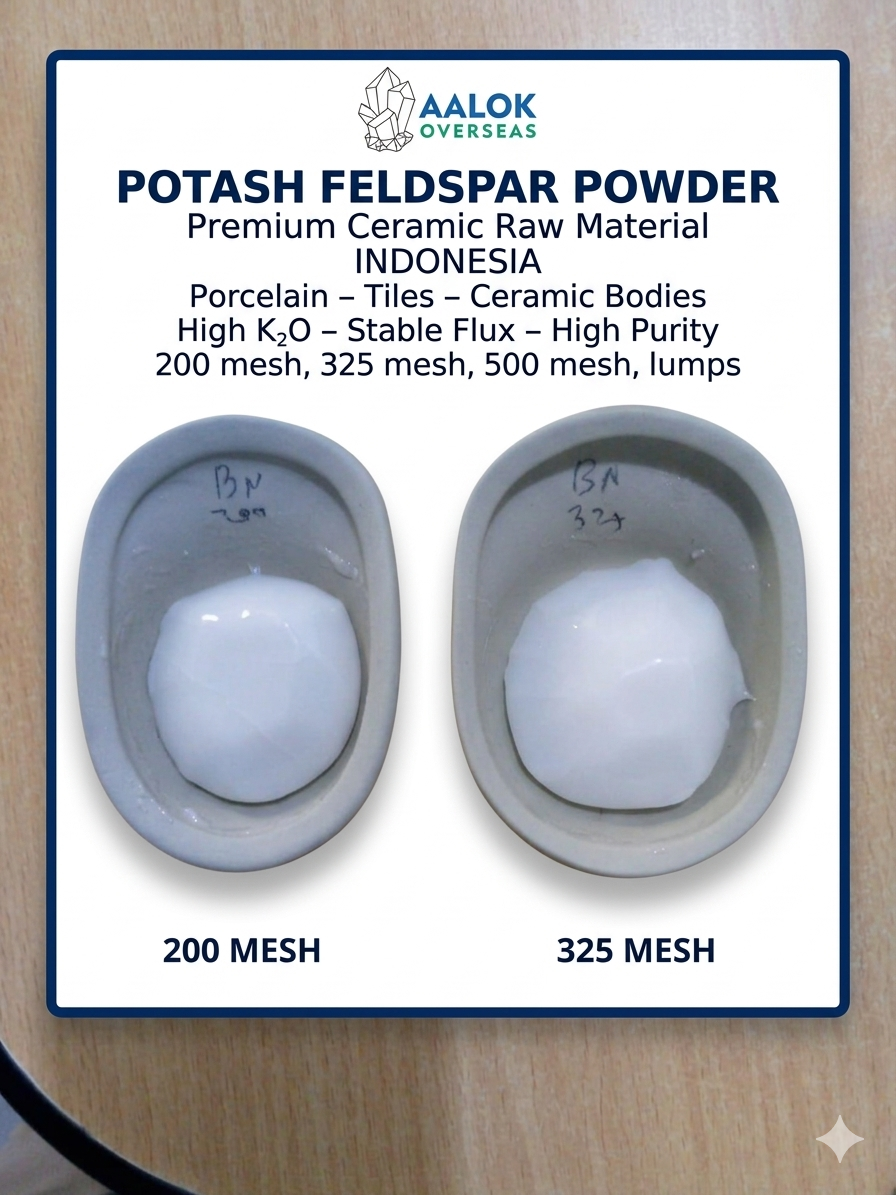
Potassium Oxide
Ultra-Low Iron
Fired Body
GCC Case Study
Plant Trial
Dispatch Time
200 · 325 · 500
Exported To
Results Achieved Within 60–90 Days
🔍 The Problem
A leading GCC tile manufacturer producing Porcelain & GVT tiles was facing:
- 6.5% average rejection rate across production lines
- Shade variation across batches — inconsistent fired colour
- Black specks impacting export quality to UAE & Saudi markets
- Inconsistent firing cycles causing higher fuel consumption
📊 Root Cause Analysis
Independent lab + plant trials identified:
- Fluctuating Na₂O / K₂O ratios in feldspar supply
- Higher Fe₂O₃ content causing discolouration defects
- Inconsistent particle size distribution (PSD)
- Batch-to-batch variation in raw material supply
- Conclusion: Raw material inconsistency was driving production loss
⚙️ Solution Implemented
Switch to controlled-grade Potash & Sodium Feldspar from Aalok Overseas with:
- Low iron content — Fe₂O₃ consistently below 0.10%
- Optimised particle size — 200 mesh and 325 mesh
- Consistent batch supply from fixed dedicated mine
- Stable Na₂O / K₂O ratios — every container
💸 Business Impact
- Thousands of sqm saved per month from reduced rejections
- Lower cost per tile — direct margin improvement
- Improved export acceptance rates in UAE & Saudi markets
- Stronger positioning in premium tile segment
- Stable, predictable production planning
Potassium feldspar — also called potash feldspar, K-feldspar, K-spar, or orthoclase feldspar — is one of the most abundant and commercially important minerals on earth. Its chemical formula is KAlSi₃O₈. It is the primary fluxing agent in ceramic, tile, porcelain, glaze, glass, and industrial manufacturing worldwide.
- Feldspar accounts for approximately 60% of the earth's crust by volume — the most abundant mineral group
- Global feldspar production exceeds 28 million metric tonnes per year — India is a top 5 producer
- The global feldspar market exceeds USD 800 million, growing at 4.5% CAGR
- Potassium feldspar constitutes 20–35% of a ceramic tile body by weight — the largest non-clay raw material
- In sanitaryware slip, potash feldspar accounts for 20–30% of the total dry batch
- India exports feldspar to over 40 countries — Southeast Asia and GCC are the largest growth markets
- A tile plant consuming 500 MT/month of feldspar can save USD 15,000–25,000/year by switching to consistent high-K₂O, low-iron dedicated mine feldspar
- Potassium feldspar melts between 1150°C and 1280°C — ideal flux range for tunnel kiln ceramic firing
- Every 1% increase in K₂O in your feldspar = approximately 8–12% improvement in vitrification efficiency at the same temperature
Potassium Feldspar — Complete Chemical & Physical Specifications
Chemical Composition — Aalok Overseas Potash Feldspar
| Parameter | Typical Value | Premium Grade | Industry Significance |
|---|---|---|---|
| SiO₂ (Silica) | 64–68% | 65–67% | Framework oxide — structural backbone of feldspar lattice |
| Al₂O₃ (Alumina) | 17–20% | 18–19.5% | Refractoriness, mechanical strength, viscosity control in melt |
| K₂O (Potassium Oxide) | 10–13% | 11–13% | Primary flux — vitrification driver, glassy matrix formation |
| Na₂O (Sodium Oxide) | 1–3% | 1–2% | Secondary flux — minor contribution |
| Fe₂O₃ (Iron Oxide) | <0.10% | <0.08% | Whiteness control — iron causes yellowing and shade variation |
| TiO₂ (Titanium Oxide) | <0.05% | <0.04% | Colour purity — low TiO₂ ensures no grey cast in fired body |
| CaO (Calcium Oxide) | <0.5% | <0.3% | Minor flux component |
| LOI (Loss on Ignition) | <0.5% | <0.3% | Clean firing — no gas evolution, no bloating, no pinholes |
| Whiteness L* (Fired) | 88–94 | 90–94 | Visual quality benchmark — ceramic body brightness |
Physical Parameters
|
Parameter |
Specification |
Application Notes |
|
Mesh Grades |
200 mesh · 325 mesh · 500 mesh |
Custom PSD available on request |
|
200 Mesh (75 microns) |
D97 < 75 μm |
Standard — tile body, sanitaryware slip |
|
325 Mesh (45 microns) |
D97 < 45 μm |
Porcelain, bone china, glaze, frit |
|
500 Mesh (25 microns) |
D97 < 25 μm |
Premium fine china, speciality glaze |
|
Specific Gravity |
2.56 – 2.62 g/cm³ |
Consistent across all batches |
|
Melting Point |
1150°C – 1280°C |
Ideal for tunnel kiln ceramic firing |
|
Moisture |
<1% |
Dried before packing |
|
Colour (Fired Button) |
Snow white to bright white |
Button tested every batch before dispatch |
|
Packaging |
25 kg / 50 kg HDPE bags · 1MT jumbo bags |
Export-grade moisture-proof packaging |
The Science Behind Potassium Feldspar — How K₂O Works in Your Kiln
Organic materials burn off (reflected in LOI). Low LOI (<0.5%) means minimal gas evolution — no bloating, no pinholes. This is where inconsistent feldspar with high LOI begins causing defects.
K₂O begins reacting with Al₂O₃ and SiO₂. A viscous glass phase starts forming. Inconsistent K₂O ratios here cause uneven vitrification — the direct cause of shade variation across a production batch.
The K₂O-Al₂O₃-SiO₂ glass phase reaches full fluidity and fills all pore spaces. Higher K₂O = denser body = lower water absorption = higher strength. Fe₂O₃ above 0.10% causes black spots at this stage.
The glass phase solidifies, locking the fired body into a rigid, glassy matrix. Consistent K₂O means consistent shrinkage — the key to dimensional stability and zero warpage in GVT and PGVT tiles.
Industries That Use Potassium Feldspar — Global Applications
25–35% of body. 325 mesh preferred. K₂O above 11% required. Fe₂O₃ below 0.10% for white body. Most rejection-sensitive application.
20–35% of tile body. Controls vitrification, strength, whiteness, dimensional stability. 200 mesh standard grade.
20–30% of casting slip. White opaque dense body. Fe₂O₃ below 0.08% mandatory. 200 mesh standard.
15–20% of body. K₂O above 11%, Fe₂O₃ below 0.08%. 325 mesh essential. Translucency and whiteness critical.
Primary K₂O + Al₂O₃ + SiO₂ source in glaze batch. Controls melt viscosity, gloss, surface tension. 325 mesh.
Alumina and alkali source. Reduces melting temperature, controls viscosity, improves chemical durability of glass.


Leave a Comment