indianceramica@gmail.com - GST NO. : 23ASHPA0569P1ZM
- Send Email


Posted by Admin on April, 13, 2026
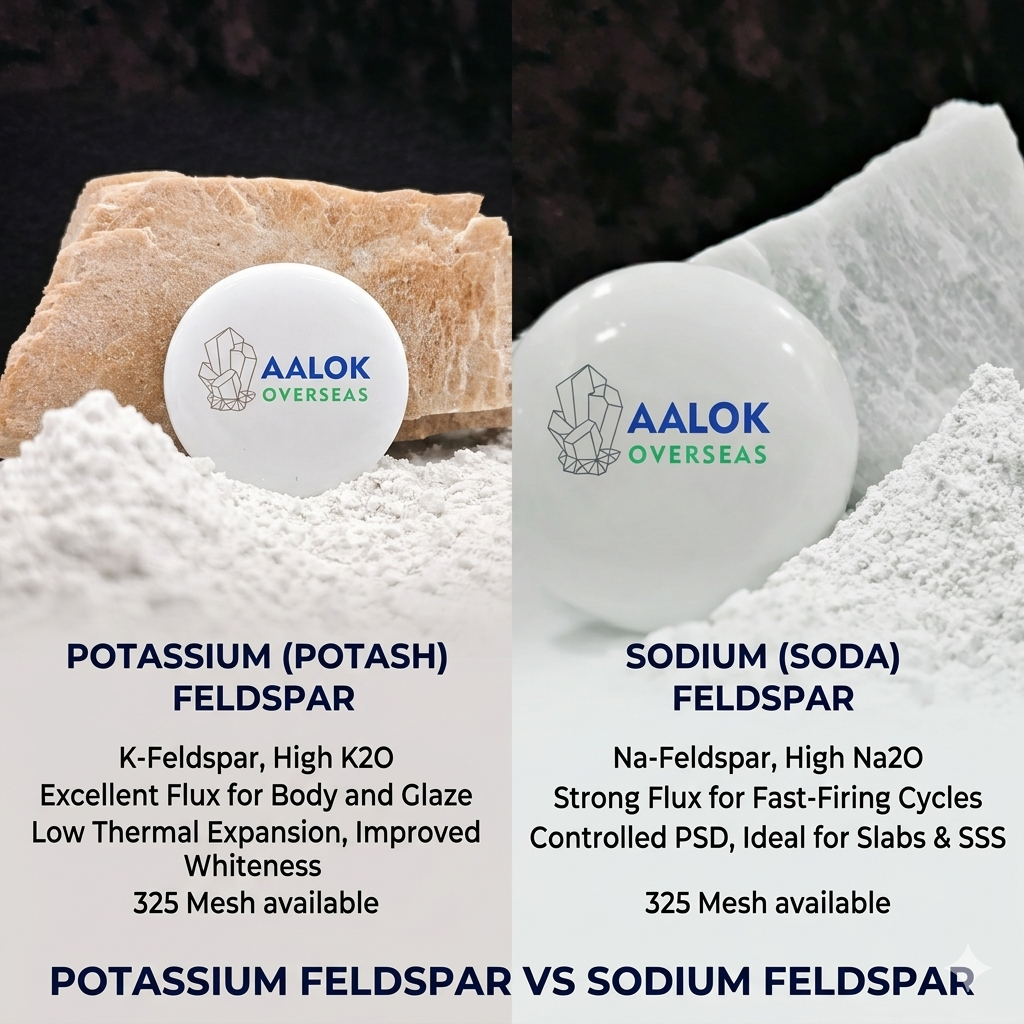
Potash Feldspar vs Soda Feldspar
They're Not Interchangeable.
Here's Why It Matters.
Same mineral family. Very different behaviour in your kiln, your glaze, and your fired product. India's best feldspar supplier explains the chemistry, the applications, and the right choice for your production.
One Wrong Grade. Thousands of Defective Pieces.
Ceramic manufacturers, glaze chemists, and procurement managers across the world often treat Potash Feldspar and Soda Feldspar as interchangeable raw materials. They are not — and the consequences of mixing them up range from glaze crazing and colour shift to body deformation and failed vitrification tests.
Both belong to the Feldspar mineral group — the most abundant mineral family in the Earth's crust — and both share the role of flux in ceramic manufacturing. But their dominant alkali oxides (K₂O vs Na₂O) create fundamentally different glassy phase behaviour at sintering temperatures, different thermal expansion coefficients, different whiteness outcomes, and different compatibility profiles with other ceramic body ingredients.
At Aalok Overseas India — India's leading feldspar manufacturer and exporter from Rajasthan — we supply both grades at international quality standards. More importantly, our technical team helps you confirm which grade is right for your application before you commit to a shipment.
Potash Feldspar vs Soda Feldspar — The Core Differences
Here is the definitive side-by-side technical breakdown from Aalok Overseas India:
Complete Technical Data Comparison — Numbers That Matter
| Parameter | ⬡ Potash Feldspar (K-Spar) | ⬡ Soda Feldspar (Na-Spar) | Significance for Ceramic Production |
|---|---|---|---|
| Dominant Alkali Oxide | K₂O: 10–12% | Na₂O: 8–11% | Determines flux type, viscosity, and fired colour |
| SiO₂ Content | 63–67% | 64–68% | Higher silica = harder body matrix |
| Al₂O₃ Content | 18–22% | 18–22% | Both provide similar alumina levels |
| Fe₂O₃ (Iron Oxide) | <0.10% (Aalok Premium) | <0.12% (Aalok Grade) | Lower Fe₂O₃ = whiter fired body |
| Melting / Fusion Point | 1,150 – 1,200°C | 1,100 – 1,120°C | K-spar melts later = safer for tall / heavy ware |
| Glassy Phase Viscosity | HIGH — viscous, stable | LOW — fluid, mobile | High viscosity prevents sagging / deformation |
| Fluxing Aggressiveness | Moderate / Controlled | Aggressive early flux | Na-spar closes porosity faster at lower temp |
| Thermal Expansion Coeff. | ~6 × 10⁻⁶ /°C (Lower) | ~8 × 10⁻⁶ /°C (Higher) | Lower expansion = reduced glaze crazing risk |
| Fired Whiteness (L*) | Bright cool white — L* 92–96 | Warm creamy tone — L* 88–93 | Critical for sanitaryware & tableware specifications |
| Glaze Colour Response | Neutral colour response | Brighter colour development | Na-spar enhances colorant vibrancy in glazes |
| Specific Gravity | 2.55 – 2.63 g/cm³ | 2.62 – 2.65 g/cm³ | For slip density calculations |
| Mohs Hardness | 6.0 – 6.5 | 6.0 – 6.5 | Similar hardness in both types |
| Dielectric Strength | Superior — >25 kV/mm | Lower | K-spar required for electrical porcelain |
| Crazing Risk in Glazes | Low — safer above 30% | Can craze at >30% content | K-spar is safer at high glaze loading levels |
| Cost Efficiency | Standard-Premium | Standard (slightly lower cost) | Na-spar often more cost-efficient for glazes |
| Mineralogy | Orthoclase / Microcline | Albite | Crystal system: Monoclinic/Triclinic vs Triclinic |
| Primary India Source | Rajasthan, AP, Karnataka | Rajasthan, AP, Tamil Nadu | Aalok Overseas mines both in Rajasthan |
The Quick Decision Table — Which Grade for Which Application?
Search
Recent Posts


Raise your Query
Hi! Simply click below and type your query.
Our experts will reply you very soon.
Leave a Comment