indianceramica@gmail.com - GST NO. : 23ASHPA0569P1ZM
- Send Email


Posted by Admin on May, 16, 2026
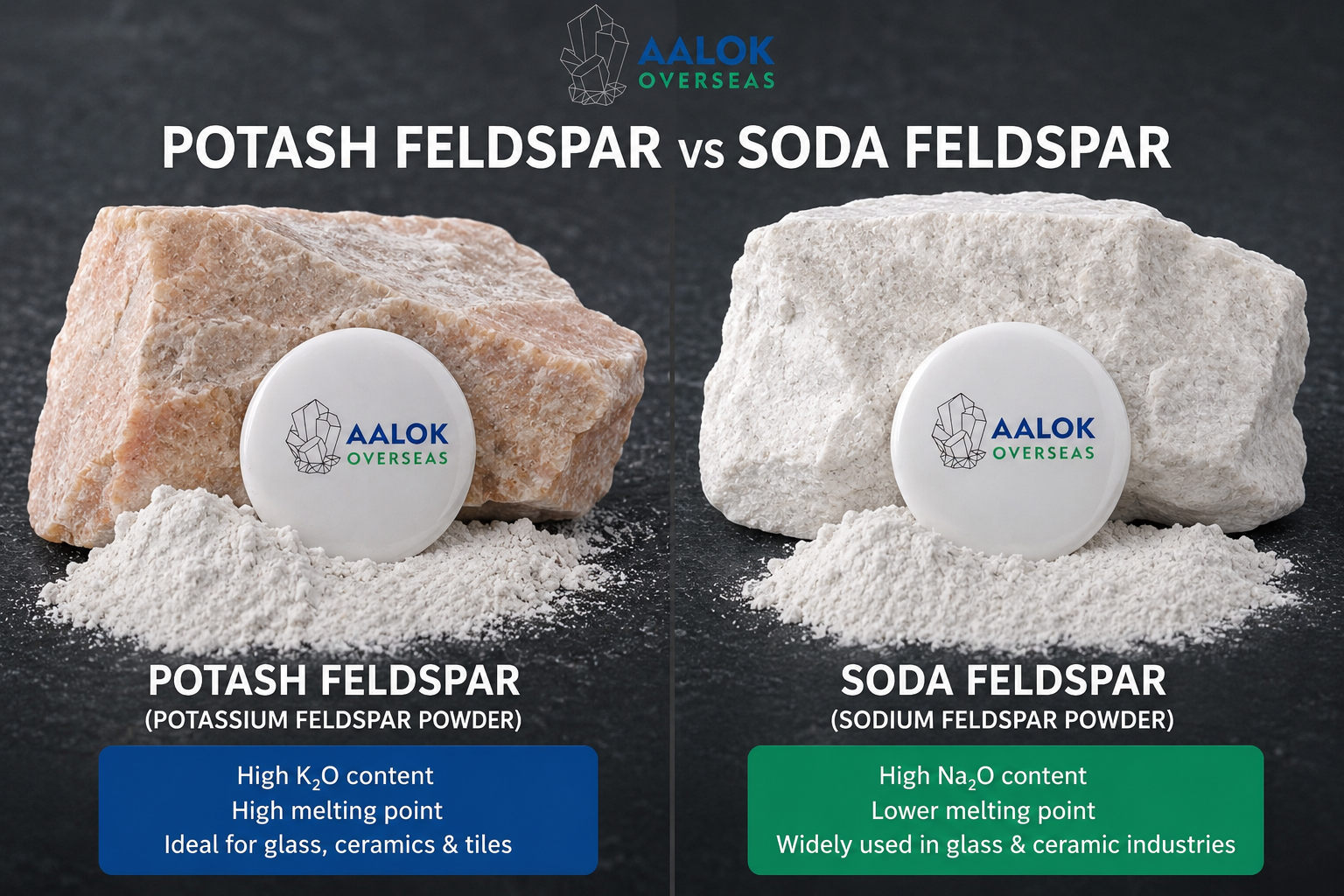
Why They Matter for Customs, Trade & Global Compliance
A CAS Number (Chemical Abstracts Service Registry Number) is a unique numerical identifier assigned to every chemical substance registered with the American Chemical Society's Chemical Abstracts Service. It is the universal language of chemistry — used by customs authorities, regulatory agencies, laboratories, shipping companies, and industrial buyers in every country to unambiguously identify a substance regardless of its trade name, common name, or language.
For minerals like feldspar and quartz, CAS numbers appear on the MSDS/SDS (Material Safety Data Sheet), the Certificate of Analysis (COA), import/export declarations, REACH registrations, and customs clearance documents. In many countries including the EU, USA, South Korea, Japan, Turkey, China, and Australia, shipments without a valid CAS number on the MSDS are routinely held at customs, rejected, or subjected to costly re-testing.
Aalok Overseas / FeldsparIndia.com provides complete MSDS/SDS documents, COAs, and export documentation with all applicable CAS numbers for every product. Our documents are GHS Rev.7 compliant and accepted by customs authorities in 50+ countries.
| Substance / Oxide | CAS Number | Chemical Formula | Typical % in K-Spar | Typical % in Na-Spar | Typical % in Quartz | Role / Significance |
|---|---|---|---|---|---|---|
| Feldspar (Natural) | 68476-25-5 | KAlSi₃O₈ / NaAlSi₃O₈ | 100% (mineral) | 100% (mineral) | — | Primary CAS on MSDS/SDS & customs docs |
| Potash Feldspar (Orthoclase) | 12251-43-3 | KAlSi₃O₈ | Dominant phase | <5% | — | K-feldspar phase; used for EU REACH section 3 |
| Soda Feldspar (Albite) | 12244-10-9 | NaAlSi₃O₈ | <15% | Dominant phase | — | Na-feldspar phase; critical for glaze buyers |
| Silicon Dioxide (SiO₂) | 7631-86-9 | SiO₂ (amorphous) | 64–68% | 65–69% | 97–99.9% | Glass network former; dominant oxide in all feldspars |
| Quartz (Crystalline SiO₂) | 14808-60-7 ⚠ | SiO₂ (crystalline) | present | present | 97–99.9% | ⚠ IARC Group 1 — RCS hazard; mandatory on MSDS for EU/US/UK |
| Aluminium Oxide (Al₂O₃) | 1344-28-1 | Al₂O₃ | 17–20% | 18–21% | <0.5% | Refractory strength, hardness, thermal resistance |
| Potassium Oxide (K₂O) | 12136-45-7 | K₂O | 10–13% ⭐ | <2% | <0.1% | Primary flux at 1000–1200°C; key differentiator for K-spar |
| Sodium Oxide (Na₂O) | 1313-59-3 | Na₂O | <3% | 8–12% ⭐ | <0.05% | Lower-melting flux; essential for glaze & glass |
| Iron(III) Oxide (Fe₂O₃) | 1309-37-1 | Fe₂O₃ | <0.08% ✓ | <0.12% ✓ | <0.05% ✓ | Controls whiteness; most critical impurity in ceramics |
| Titanium Dioxide (TiO₂) | 13463-67-7 | TiO₂ | <0.02% | <0.02% | <0.05% | Causes yellowing; ultra-low for white sanitaryware |
| Calcium Oxide (CaO) | 1305-78-8 | CaO | <1% | <1.5% | <0.1% | Can cause lime pitting if >2%; check in ceramic bodies |
| Magnesium Oxide (MgO) | 1309-48-4 | MgO | <0.1% | <0.1% | <0.05% | Minor flux; low levels preferred for body consistency |
| Loss on Ignition (LOI) | N/A (not a substance) | CO₂, H₂O volatiles | <0.5% | <0.5% | <0.3% | High LOI = kiln gas & blistering risk in fired ware |
| Product | CAS Number | HS Code (6-digit) | EC / EINECS No. | REACH Reg. No. | Customs Description |
|---|---|---|---|---|---|
| Feldspar (All Types) | 68476-25-5 | 2529.10.00 | 270-666-7 | 01-2119455851-35 | Natural feldspathic minerals; ground or unground |
| Potash Feldspar (Orthoclase) | 12251-43-3 | 2529.10.00 | 235-491-3 | 01-2119455851-35 | Potassium aluminium silicate; K-Spar; Orthoclase |
| Soda Feldspar (Albite) | 12244-10-9 | 2529.10.00 | 235-468-8 | 01-2119455851-35 | Sodium aluminium silicate; Albite; Na-Spar |
| Quartz / Natural SiO₂ | 14808-60-7 | 2506.10.00 | 238-878-4 | 01-2119458434-33 | Quartz (crystalline silica); natural, crude or ground |
| Quartz Powder / Silica Flour | 14808-60-7 | 2811.22.00 | 238-878-4 | 01-2119458434-33 | Silicon dioxide (ground); silica flour; micronized silica |
| Silica Sand / Quartz Sand | 14808-60-7 | 2505.10.00 | 238-878-4 | 01-2119458434-33 | Natural silica sands and quartz sands |
EU REACH Regulation (EC 1907/2006) requires that every substance in a product with >0.1% concentration must be listed with its CAS number and EC number in Section 3 of the SDS. Importers in Germany, Italy, Spain, France, the Netherlands, Poland, and all EU states will reject shipments where the SDS omits CAS numbers. The feldspar REACH registration (01-2119455851-35) must appear on documentation.
OSHA Hazard Communication Standard (HCS 2012) aligns with GHS and mandates CAS numbers for all identified hazardous components in the SDS. The FDA and EPA also use CAS numbers for substance tracking. US customs (CBP) increasingly cross-references CAS data for minerals classified under Schedule B export codes and HTS import codes.
Japan's Chemical Substances Control Law (CSCL) and Industrial Safety and Health Law (ISHL) require CAS numbers on SDSs for chemical imports. The Japan Ministry of Health, Labour and Welfare (MHLW) maintains its own substance database cross-referenced by CAS. Feldspar exports to Japan must include CAS 68476-25-5 and comply with JIS Z 7253 (GHS-aligned SDS standard).
Korea's Act on Registration and Evaluation of Chemicals (K-REACH, Act No. 11789) closely mirrors EU REACH. CAS numbers are mandatory for all chemical substances imported into Korea above 100 kg/year. Korean buyers in the ceramics and tile sector require CAS-referenced SDS and often request Korean-language translated documents.
Turkey's KKDIK (Registration, Evaluation, Authorisation and Restriction of Chemicals) regulation, modelled on EU REACH, came into force in 2017. CAS numbers are required on Turkish SDS (GBF — Güvenlik Bilgi Formu) for all mineral imports. Turkish ceramic tile manufacturers — one of the world's largest tile-producing sectors — specifically require CAS-verified documentation.
China's Measures for the Environmental Management of New Chemical Substances and GB/T 16483 (SDS standard) require CAS numbers on all chemical safety documentation. Chinese customs (GACC) uses CAS numbers for customs declaration category verification. Feldspar and quartz are classified under China's HS tariff with specific declaration requirements including CAS.
The Australian Industrial Chemicals Introduction Scheme (AICIS) replaced NICNAS from July 2020. Importers of industrial minerals must verify CAS numbers against the AICIS inventory. CAS-verified SDS documents are required for customs and workplace health compliance under the Safe Work Australia GHS framework (WHS Regulations 2017).
Gulf Cooperation Council (GCC) countries (Saudi Arabia, UAE, Qatar, Kuwait, Bahrain, Oman) follow GSO technical standards which adopt GHS for chemical management. UAE's CICPA and Saudi Arabia's SASO require CAS-referenced SDS for industrial chemical imports. Indian feldspar suppliers exporting to the GCC must provide Arabic or bilingual SDS with valid CAS numbers.
| Component / Substance | CAS Number | EC Number | Concentration | GHS Classification |
|---|---|---|---|---|
| Feldspar (Natural) | 68476-25-5 | 270-666-7 | ≥85% | Not classified |
| Crystalline Silica (Quartz) | 14808-60-7 ⚠ | 238-878-4 | 1–10% | Carc. 1A (inhaled); IARC Group 1 |
| Aluminium Oxide (Al₂O₃) | 1344-28-1 | 215-691-6 | 17–20% | Not classified |
| Potassium Oxide (K₂O) | 12136-45-7 | 235-217-3 | 10–13% | Not classified (bound form) |
| Iron(III) Oxide (Fe₂O₃) | 1309-37-1 | 215-168-2 | <0.08% | Not classified at <1% |
© 2025 Aalok Overseas · Rajasthan, India · FIEO Member · IEC Holder · GHS/REACH Compliant Documentation · Export to 50+ Countries
Search
Recent Posts


Leave a Comment