indianceramica@gmail.com - GST NO. : 23ASHPA0569P1ZM
- Send Email


Posted by Admin on April, 24, 2026
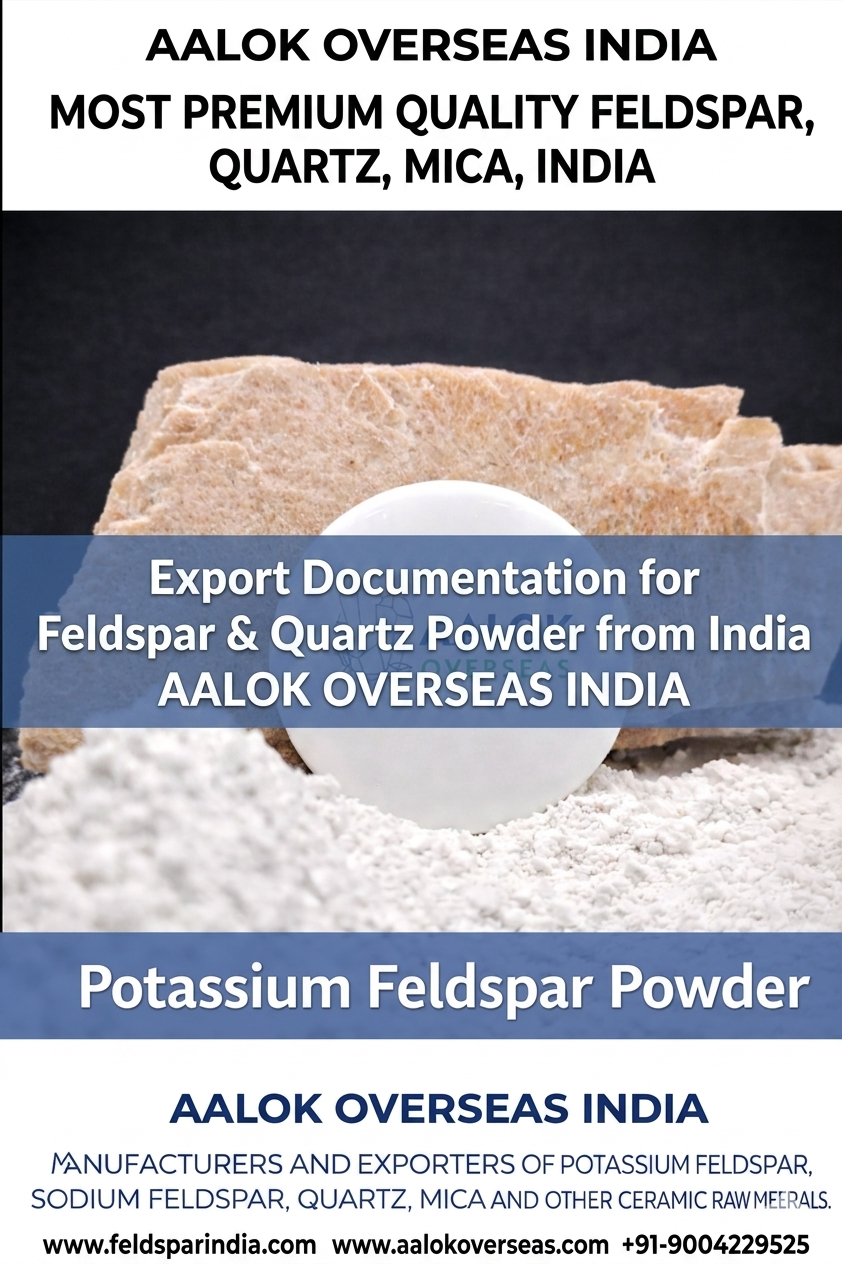
Export Intelligence · Aalok Overseas India · Rajasthan
Export Documentation for
Feldspar & Quartz Powder from India
The complete, authoritative guide to every document required for exporting Potassium Feldspar, Sodium Feldspar, and Quartz / Silica Powder from India — covering shipping documents, quality certificates, XRF CoA, Free Trade Agreements (AIFTA, SAFTA, ASFTA, IUSFTA, ISFTA, CEPA), customs procedures, HS codes, and duty benefits for buyers in Vietnam, Indonesia, Malaysia, Turkey, Bangladesh, Sri Lanka, UAE, Saudi Arabia, and beyond.
#ExportDocumentation#FeldsparExport#QuartzExport#AIFTA#SAFTA#CertificateOfOrigin#XRFReport#IndiaExportCompliance
Enquire Now View Products
Key Export Facts — Feldspar & Quartz from India
2508.10
HS Code
Feldspar
2616.90
HS Code
Quartz / Silica
6+
Active FTAs
India Offers
0%
Duty Under
AIFTA / SAFTA
12+
Documents in
Full Export Set
Overview
The complete, authoritative guide to every document required for exporting Potassium Feldspar, Sodium Feldspar, and Quartz / Silica Powder from India — covering shipping documents, quality certificates, XRF CoA, Free Trade Agreements (AIFTA, SAFTA, ASFTA, IUSFTA, ISFTA, CEPA), customs procedures, HS codes, and duty benefits for buyers in Vietnam, Indonesia, Malaysia, Turkey, Bangladesh, Sri Lanka, UAE, Saudi Arabia, and beyond.
Feldspar
Quartz / Silica
India Offers
AIFTA / SAFTA
Full Export Set
Why Export Documentation Matters for Mineral Exporters
Exporting industrial minerals like Potassium Feldspar, Sodium Feldspar, and Quartz Powder from India is not simply a logistics exercise. It is a compliance, chemistry, and commercial documentation exercise — and the documents you provide as a supplier determine whether your buyer's customs clearance takes 2 days or 2 weeks, whether they qualify for zero-duty import under an applicable Free Trade Agreement, and whether their internal quality team approves the material before it enters their production line.
At Aalok Overseas, we treat export documentation as an extension of our quality commitment. Every shipment is accompanied by a full document set — from XRF Certificate of Analysis and Whiteness Report through to correctly classified commercial invoices, FTA-specific Certificates of Origin, and destination-port-specific packing compliance. This guide explains every document, its purpose, and the specific FTA benefit it unlocks.
HS Codes for reference: Feldspar (all types) → HS 2508.10 | Quartz / Natural Silica Sand → HS 2616.90 / 2505 | Ground Silica / Quartz Powder → HS 2616.90 / 2505.10 | Always verify with your Customs House Agent for destination-country tariff classification.
Master Checklist
Exporting industrial minerals like Potassium Feldspar, Sodium Feldspar, and Quartz Powder from India is not simply a logistics exercise. It is a compliance, chemistry, and commercial documentation exercise — and the documents you provide as a supplier determine whether your buyer's customs clearance takes 2 days or 2 weeks, whether they qualify for zero-duty import under an applicable Free Trade Agreement, and whether their internal quality team approves the material before it enters their production line.
At Aalok Overseas, we treat export documentation as an extension of our quality commitment. Every shipment is accompanied by a full document set — from XRF Certificate of Analysis and Whiteness Report through to correctly classified commercial invoices, FTA-specific Certificates of Origin, and destination-port-specific packing compliance. This guide explains every document, its purpose, and the specific FTA benefit it unlocks.
HS Codes for reference: Feldspar (all types) → HS 2508.10 | Quartz / Natural Silica Sand → HS 2616.90 / 2505 | Ground Silica / Quartz Powder → HS 2616.90 / 2505.10 | Always verify with your Customs House Agent for destination-country tariff classification.
Complete Export Document Set — Feldspar & Quartz
Every document below serves a specific commercial, regulatory, or quality purpose. This is the full set Aalok Overseas prepares for every international shipment.
# Document Issued By Purpose Mandatory?
01
Commercial Invoice
Exporter (Aalok Overseas)
Establishes transaction value, goods description, HS code, terms of sale (Incoterms), and payment basis for customs valuation
YES
02
Packing List
Exporter (Aalok Overseas)
Details number of bags/packages, net weight, gross weight, container number, and seal number. Used by customs and buyer's receiving team
YES
03
Bill of Lading (B/L)
Shipping Line
Title document for the cargo. Required by buyer's bank for LC transactions. Triggers release of goods at destination port. Original B/L or Telex Release depending on payment terms
YES
04
Certificate of Origin (CoO)
DGFT / Export Promotion Council / Chamber of Commerce
Confirms goods originate in India. Generic CoO (non-preferential) is for standard use. FTA-specific preferential CoO unlocks zero or reduced duty rates
YES
05
XRF Certificate of Analysis (CoA)
Exporter's in-house lab / NABL-accredited third-party lab
Reports full oxide chemistry (SiO₂, Al₂O₃, K₂O, Na₂O, Fe₂O₃, TiO₂, CaO, MgO, LOI) of the actual production batch. Used by buyer's R&D / QC team for incoming inspection and body formulation verification
YES*
06
Whiteness / Brightness Report
Exporter's QC lab / third-party lab
GE or ISO whiteness index measured on fired or unfired powder. Critical for ceramic, sanitaryware, and engineered stone buyers where whiteness is a contracted specification
YES*
07
Material Safety Data Sheet (MSDS / SDS)
Exporter / Manufacturer
GHS-compliant safety data sheet covering mineral identification, hazard classification, handling, storage, and emergency procedures. Required by customs in most countries and by buyer's EHS team
YES
08
Shipping Bill (Export Declaration)
Exporter via Indian Customs (ICEGATE)
India's export customs declaration filed electronically. Serves as proof of export for GST refund (IGST drawback), and is a supporting document for export incentive schemes
YES
09
Phytosanitary / Health Certificate
APEDA / State Agriculture Dept (if required)
Not typically required for processed mineral powders. May be required in exceptional cases by specific destination country customs for naturally occurring mineral imports
Conditional
10
Fumigation Certificate
Licensed fumigation agency
Required when wooden pallets or wooden packing materials are used (ISPM-15). For mineral powders in PP bags, fumigation certificate is typically not required unless specified by destination country
Conditional
11
Bank Realisation Certificate (BRC / eBRC)
Exporter's bank
Confirms foreign exchange realisation from export. Required for IGST drawback claims, export incentive schemes (RoDTEP), and FEMA compliance. Post-shipment document
YES*
12
Particle Size Distribution (PSD) Report
Exporter's lab / third-party
D10, D50, D90 values confirming mesh specification. Required by buyers using ultra-fine grades (325–600 mesh) for engineered stone, glazes, or paints where particle size directly affects processing performance
As specified
* YES* = Mandatory for Aalok Overseas shipments as standard practice, even where not legally required by destination customs — because buyer's QC team requires it for production approval.
Quality Certificate Deep Dive
Every document below serves a specific commercial, regulatory, or quality purpose. This is the full set Aalok Overseas prepares for every international shipment.
| # | Document | Issued By | Purpose | Mandatory? |
|---|---|---|---|---|
| 01 | Commercial Invoice | Exporter (Aalok Overseas) | Establishes transaction value, goods description, HS code, terms of sale (Incoterms), and payment basis for customs valuation | YES |
| 02 | Packing List | Exporter (Aalok Overseas) | Details number of bags/packages, net weight, gross weight, container number, and seal number. Used by customs and buyer's receiving team | YES |
| 03 | Bill of Lading (B/L) | Shipping Line | Title document for the cargo. Required by buyer's bank for LC transactions. Triggers release of goods at destination port. Original B/L or Telex Release depending on payment terms | YES |
| 04 | Certificate of Origin (CoO) | DGFT / Export Promotion Council / Chamber of Commerce | Confirms goods originate in India. Generic CoO (non-preferential) is for standard use. FTA-specific preferential CoO unlocks zero or reduced duty rates | YES |
| 05 | XRF Certificate of Analysis (CoA) | Exporter's in-house lab / NABL-accredited third-party lab | Reports full oxide chemistry (SiO₂, Al₂O₃, K₂O, Na₂O, Fe₂O₃, TiO₂, CaO, MgO, LOI) of the actual production batch. Used by buyer's R&D / QC team for incoming inspection and body formulation verification | YES* |
| 06 | Whiteness / Brightness Report | Exporter's QC lab / third-party lab | GE or ISO whiteness index measured on fired or unfired powder. Critical for ceramic, sanitaryware, and engineered stone buyers where whiteness is a contracted specification | YES* |
| 07 | Material Safety Data Sheet (MSDS / SDS) | Exporter / Manufacturer | GHS-compliant safety data sheet covering mineral identification, hazard classification, handling, storage, and emergency procedures. Required by customs in most countries and by buyer's EHS team | YES |
| 08 | Shipping Bill (Export Declaration) | Exporter via Indian Customs (ICEGATE) | India's export customs declaration filed electronically. Serves as proof of export for GST refund (IGST drawback), and is a supporting document for export incentive schemes | YES |
| 09 | Phytosanitary / Health Certificate | APEDA / State Agriculture Dept (if required) | Not typically required for processed mineral powders. May be required in exceptional cases by specific destination country customs for naturally occurring mineral imports | Conditional |
| 10 | Fumigation Certificate | Licensed fumigation agency | Required when wooden pallets or wooden packing materials are used (ISPM-15). For mineral powders in PP bags, fumigation certificate is typically not required unless specified by destination country | Conditional |
| 11 | Bank Realisation Certificate (BRC / eBRC) | Exporter's bank | Confirms foreign exchange realisation from export. Required for IGST drawback claims, export incentive schemes (RoDTEP), and FEMA compliance. Post-shipment document | YES* |
| 12 | Particle Size Distribution (PSD) Report | Exporter's lab / third-party | D10, D50, D90 values confirming mesh specification. Required by buyers using ultra-fine grades (325–600 mesh) for engineered stone, glazes, or paints where particle size directly affects processing performance | As specified |
* YES* = Mandatory for Aalok Overseas shipments as standard practice, even where not legally required by destination customs — because buyer's QC team requires it for production approval.
The XRF Certificate of Analysis — What It Is and Why It Matters
The XRF Certificate of Analysis (CoA) is the most commercially critical quality document in a mineral export transaction. XRF — X-Ray Fluorescence — is the analytical technique used to determine the elemental and oxide composition of a mineral sample with high accuracy and repeatability. The CoA based on XRF analysis gives the buyer's R&D and QC teams the precise chemical fingerprint of the specific production batch in their shipment.
What XRF Measures
SiO₂ · Al₂O₃ · K₂O · Na₂O · Fe₂O₃ · TiO₂ · CaO · MgO · MnO · P₂O₅ · LOI (Loss on Ignition). For feldspar, K₂O and Na₂O are the flux indicators. For quartz, SiO₂ purity and Fe₂O₃ are decisive. Every value is expressed as weight percentage of the analysed sample.
Batch-Specific vs. Catalogue CoA
A catalogue CoA shows the product's typical or average values — not the actual values of the batch you receive. A batch-specific CoA is run on the actual production lot loaded into your container. Aalok Overseas issues batch-specific XRF CoA only — the lot number on the CoA matches the lot number on the bags.
NABL vs. In-House Testing
NABL (National Accreditation Board for Testing and Calibration Laboratories) accreditation gives a CoA official standing for regulatory and customs purposes. In-house XRF CoA from a calibrated instrument is sufficient for most commercial purposes. For buyers requiring NABL-stamped CoA, third-party testing can be arranged.
What a CoA Must Include
Product name · HS code · Production lot / batch number · Date of analysis · Analytical method (XRF) · Full oxide table with values and units · Whiteness value · Mesh / fineness · Issuing lab name · Authorised signatory. Without all of these, a CoA is incomplete.
⚠ BUYER CAUTION — How to Spot a Catalogue CoA vs. a Real Batch CoA
If a supplier's CoA shows the same values across three different orders placed six months apart — same K₂O to two decimal places, same Fe₂O₃, same LOI — it is almost certainly a catalogue specification document, not a batch-specific analysis. Real XRF values vary slightly between production runs even from the same mine. Batch-specific CoA values will show minor natural variation (e.g. K₂O 10.42% in one batch, 10.38% in the next) — this variation is evidence of real testing, not a quality problem. Identical values across every shipment is the quality problem.
Free Trade Agreements
The XRF Certificate of Analysis (CoA) is the most commercially critical quality document in a mineral export transaction. XRF — X-Ray Fluorescence — is the analytical technique used to determine the elemental and oxide composition of a mineral sample with high accuracy and repeatability. The CoA based on XRF analysis gives the buyer's R&D and QC teams the precise chemical fingerprint of the specific production batch in their shipment.
SiO₂ · Al₂O₃ · K₂O · Na₂O · Fe₂O₃ · TiO₂ · CaO · MgO · MnO · P₂O₅ · LOI (Loss on Ignition). For feldspar, K₂O and Na₂O are the flux indicators. For quartz, SiO₂ purity and Fe₂O₃ are decisive. Every value is expressed as weight percentage of the analysed sample.
A catalogue CoA shows the product's typical or average values — not the actual values of the batch you receive. A batch-specific CoA is run on the actual production lot loaded into your container. Aalok Overseas issues batch-specific XRF CoA only — the lot number on the CoA matches the lot number on the bags.
NABL (National Accreditation Board for Testing and Calibration Laboratories) accreditation gives a CoA official standing for regulatory and customs purposes. In-house XRF CoA from a calibrated instrument is sufficient for most commercial purposes. For buyers requiring NABL-stamped CoA, third-party testing can be arranged.
Product name · HS code · Production lot / batch number · Date of analysis · Analytical method (XRF) · Full oxide table with values and units · Whiteness value · Mesh / fineness · Issuing lab name · Authorised signatory. Without all of these, a CoA is incomplete.
If a supplier's CoA shows the same values across three different orders placed six months apart — same K₂O to two decimal places, same Fe₂O₃, same LOI — it is almost certainly a catalogue specification document, not a batch-specific analysis. Real XRF values vary slightly between production runs even from the same mine. Batch-specific CoA values will show minor natural variation (e.g. K₂O 10.42% in one batch, 10.38% in the next) — this variation is evidence of real testing, not a quality problem. Identical values across every shipment is the quality problem.
India's Free Trade Agreements — Duty Benefits for Feldspar & Quartz Importers
India has signed multiple bilateral and multilateral Free Trade Agreements (FTAs) and Preferential Trade Agreements (PTAs) that provide significant import duty reductions or eliminations for buyers of Indian minerals including feldspar and quartz. To claim these benefits, the importer must present a preferential Certificate of Origin (CoO) issued under the specific FTA's rules of origin, along with the standard commercial documents.
FTA / Agreement Full Name Member Countries CoO Form Duty Benefit
AIFTA
ASEAN–India Free Trade Agreement
Vietnam · Indonesia · Malaysia · Thailand · Philippines · Singapore · Myanmar · Brunei · Cambodia · Laos
Form AI
0–5% (most minerals 0%)
SAFTA
South Asian Free Trade Area Agreement
Bangladesh · Sri Lanka · Pakistan · Nepal · Bhutan · Maldives · Afghanistan (SAARC members)
SAFTA CoO
0% (LDC) / Reduced (non-LDC)
India–Sri Lanka FTA (ISFTA)
India–Sri Lanka Free Trade Agreement
India · Sri Lanka (bilateral)
Form ISFTA
Reduced / 0% on eligible goods
India–UAE CEPA
India–UAE Comprehensive Economic Partnership Agreement
India · UAE (bilateral)
CEPA CoO
Phased reduction to 0%
India–Malaysia CECA
India–Malaysia Comprehensive Economic Cooperation Agreement
India · Malaysia (bilateral — in addition to AIFTA)
Form IMCECA
Enhanced beyond AIFTA rates
GSTP
Global System of Trade Preferences among Developing Countries
43 developing nations including Turkey, Bangladesh, Indonesia, Malaysia, Sri Lanka, Egypt, Morocco
GSTP CoO
Varies by product and country
India–South Korea CEPA
India–Korea Comprehensive Economic Partnership Agreement
India · South Korea (bilateral)
Form IK
Reduced to 0% on eligible HS codes
India–Japan CEPA
India–Japan Comprehensive Economic Partnership Agreement
India · Japan (bilateral)
Form IJ
Reduced duty on eligible minerals
AIFTA — Most Important FTA for Mineral Exporters
India has signed multiple bilateral and multilateral Free Trade Agreements (FTAs) and Preferential Trade Agreements (PTAs) that provide significant import duty reductions or eliminations for buyers of Indian minerals including feldspar and quartz. To claim these benefits, the importer must present a preferential Certificate of Origin (CoO) issued under the specific FTA's rules of origin, along with the standard commercial documents.
| FTA / Agreement | Full Name | Member Countries | CoO Form | Duty Benefit |
|---|---|---|---|---|
| AIFTA | ASEAN–India Free Trade Agreement | Vietnam · Indonesia · Malaysia · Thailand · Philippines · Singapore · Myanmar · Brunei · Cambodia · Laos | Form AI | 0–5% (most minerals 0%) |
| SAFTA | South Asian Free Trade Area Agreement | Bangladesh · Sri Lanka · Pakistan · Nepal · Bhutan · Maldives · Afghanistan (SAARC members) | SAFTA CoO | 0% (LDC) / Reduced (non-LDC) |
| India–Sri Lanka FTA (ISFTA) | India–Sri Lanka Free Trade Agreement | India · Sri Lanka (bilateral) | Form ISFTA | Reduced / 0% on eligible goods |
| India–UAE CEPA | India–UAE Comprehensive Economic Partnership Agreement | India · UAE (bilateral) | CEPA CoO | Phased reduction to 0% |
| India–Malaysia CECA | India–Malaysia Comprehensive Economic Cooperation Agreement | India · Malaysia (bilateral — in addition to AIFTA) | Form IMCECA | Enhanced beyond AIFTA rates |
| GSTP | Global System of Trade Preferences among Developing Countries | 43 developing nations including Turkey, Bangladesh, Indonesia, Malaysia, Sri Lanka, Egypt, Morocco | GSTP CoO | Varies by product and country |
| India–South Korea CEPA | India–Korea Comprehensive Economic Partnership Agreement | India · South Korea (bilateral) | Form IK | Reduced to 0% on eligible HS codes |
| India–Japan CEPA | India–Japan Comprehensive Economic Partnership Agreement | India · Japan (bilateral) | Form IJ | Reduced duty on eligible minerals |
ASEAN–India FTA (AIFTA) — Form AI: Complete Guide
The ASEAN–India Free Trade Agreement (AIFTA) is the single most commercially important FTA for Indian feldspar and quartz exporters. It covers Vietnam, Indonesia, Malaysia, Thailand, Philippines, Singapore, Myanmar, Brunei, Cambodia, and Laos — which together represent the majority of the global ceramic tile and sanitaryware manufacturing market outside of China.
Under AIFTA, most industrial minerals including feldspar (HS 2508.10) and quartz/silica (HS 2616.90) attract 0% import duty when imported from India into ASEAN member countries, provided the shipment is accompanied by a valid Form AI Certificate of Origin that meets AIFTA Rules of Origin criteria.
What is Form AI?
Form AI is the standardised preferential Certificate of Origin issued under AIFTA. It is issued by designated agencies in India — typically the Export Inspection Agency (EIA), Export Promotion Councils, or authorised Chambers of Commerce. It must be presented at the destination country's customs at time of import to claim the preferential (zero or reduced) duty rate.
AIFTA Rules of Origin
For minerals, the Rules of Origin under AIFTA require that the goods are wholly obtained or produced in India — which is easily met by feldspar and quartz mined and processed in Rajasthan. The "Change in Tariff Heading" (CTH) criterion or a minimum 35% Regional Value Content (RVC) criterion applies to processed goods, but is generally not an issue for naturally occurring minerals.
How to Apply for Form AI
The exporter (Aalok Overseas) submits an application to the issuing authority with: commercial invoice, packing list, shipping bill, and supporting evidence of Indian origin (mine lease/ownership documents, processing records). The issuing agency verifies and issues Form AI, which is then included in the shipment's document set.
Validity and Third-Country Invoicing
Form AI is valid for 12 months from the date of issue. Back-to-back or third-country invoicing arrangements need careful handling — the CoO must still be issued against the Indian origin shipment. Splitting containers for multiple destinations requires separate Form AI certificates per shipment.
💡 BUYER COST SAVING — HOW MUCH DOES FORM AI SAVE?
Vietnam's standard MFN import duty on feldspar (HS 2508.10) is typically 5–10% of CIF value. Under AIFTA with Form AI, this reduces to 0%. On a USD 25,000 CIF shipment (1 × 20 FCL), this represents a saving of USD 1,250–2,500 per container — in the buyer's favour, for the cost of a document. Indonesia, Malaysia, and Thailand similarly offer 0% under AIFTA. Ask your supplier if they are providing Form AI with every ASEAN-bound shipment. If they are not, you are paying import duty you do not need to pay.
SAFTA — South Asia
The ASEAN–India Free Trade Agreement (AIFTA) is the single most commercially important FTA for Indian feldspar and quartz exporters. It covers Vietnam, Indonesia, Malaysia, Thailand, Philippines, Singapore, Myanmar, Brunei, Cambodia, and Laos — which together represent the majority of the global ceramic tile and sanitaryware manufacturing market outside of China.
Under AIFTA, most industrial minerals including feldspar (HS 2508.10) and quartz/silica (HS 2616.90) attract 0% import duty when imported from India into ASEAN member countries, provided the shipment is accompanied by a valid Form AI Certificate of Origin that meets AIFTA Rules of Origin criteria.
Form AI is the standardised preferential Certificate of Origin issued under AIFTA. It is issued by designated agencies in India — typically the Export Inspection Agency (EIA), Export Promotion Councils, or authorised Chambers of Commerce. It must be presented at the destination country's customs at time of import to claim the preferential (zero or reduced) duty rate.
For minerals, the Rules of Origin under AIFTA require that the goods are wholly obtained or produced in India — which is easily met by feldspar and quartz mined and processed in Rajasthan. The "Change in Tariff Heading" (CTH) criterion or a minimum 35% Regional Value Content (RVC) criterion applies to processed goods, but is generally not an issue for naturally occurring minerals.
The exporter (Aalok Overseas) submits an application to the issuing authority with: commercial invoice, packing list, shipping bill, and supporting evidence of Indian origin (mine lease/ownership documents, processing records). The issuing agency verifies and issues Form AI, which is then included in the shipment's document set.
Form AI is valid for 12 months from the date of issue. Back-to-back or third-country invoicing arrangements need careful handling — the CoO must still be issued against the Indian origin shipment. Splitting containers for multiple destinations requires separate Form AI certificates per shipment.
Vietnam's standard MFN import duty on feldspar (HS 2508.10) is typically 5–10% of CIF value. Under AIFTA with Form AI, this reduces to 0%. On a USD 25,000 CIF shipment (1 × 20 FCL), this represents a saving of USD 1,250–2,500 per container — in the buyer's favour, for the cost of a document. Indonesia, Malaysia, and Thailand similarly offer 0% under AIFTA. Ask your supplier if they are providing Form AI with every ASEAN-bound shipment. If they are not, you are paying import duty you do not need to pay.
SAFTA — South Asian Free Trade Area: Bangladesh & Sri Lanka
The South Asian Free Trade Area (SAFTA) agreement covers India, Bangladesh, Sri Lanka, Pakistan, Nepal, Bhutan, Maldives, and Afghanistan — all SAARC member states. For Indian mineral exporters, SAFTA is most relevant for shipments to Bangladesh and Sri Lanka, which are significant ceramic tile and sanitaryware manufacturing markets.
Bangladesh under SAFTA
Bangladesh is classified as a Least Developed Country (LDC) under SAFTA. Indian exports to Bangladesh on SAFTA-eligible goods attract 0% import duty provided a valid SAFTA Certificate of Origin is presented. Feldspar and quartz are on the eligible list. Bangladesh also has a Sensitive List (items excluded from SAFTA benefits) — verify current inclusion of HS 2508.10 and 2616.90 with your CHA at time of shipment.
Sri Lanka under ISFTA + SAFTA
Sri Lanka benefits from two applicable agreements: the India–Sri Lanka Free Trade Agreement (ISFTA) (bilateral) and SAFTA (multilateral). Importers should claim under whichever agreement offers the greater duty reduction for their specific HS code. The ISFTA CoO Form is separate from the SAFTA CoO — your Customs House Agent (CHA) will advise on the optimum claim route.
SAFTA CoO Issuance
The SAFTA Certificate of Origin is issued in India by DGFT-notified agencies including the Export Inspection Council (EIC), Federation of Indian Export Organisations (FIEO), and regional Chambers of Commerce. The document must be on the prescribed format, bear the issuing authority's stamp and authorised signature, and include the specific HS code and description matching the commercial invoice.
India–UAE CEPA & GCC
The South Asian Free Trade Area (SAFTA) agreement covers India, Bangladesh, Sri Lanka, Pakistan, Nepal, Bhutan, Maldives, and Afghanistan — all SAARC member states. For Indian mineral exporters, SAFTA is most relevant for shipments to Bangladesh and Sri Lanka, which are significant ceramic tile and sanitaryware manufacturing markets.
Bangladesh is classified as a Least Developed Country (LDC) under SAFTA. Indian exports to Bangladesh on SAFTA-eligible goods attract 0% import duty provided a valid SAFTA Certificate of Origin is presented. Feldspar and quartz are on the eligible list. Bangladesh also has a Sensitive List (items excluded from SAFTA benefits) — verify current inclusion of HS 2508.10 and 2616.90 with your CHA at time of shipment.
Sri Lanka benefits from two applicable agreements: the India–Sri Lanka Free Trade Agreement (ISFTA) (bilateral) and SAFTA (multilateral). Importers should claim under whichever agreement offers the greater duty reduction for their specific HS code. The ISFTA CoO Form is separate from the SAFTA CoO — your Customs House Agent (CHA) will advise on the optimum claim route.
The SAFTA Certificate of Origin is issued in India by DGFT-notified agencies including the Export Inspection Council (EIC), Federation of Indian Export Organisations (FIEO), and regional Chambers of Commerce. The document must be on the prescribed format, bear the issuing authority's stamp and authorised signature, and include the specific HS code and description matching the commercial invoice.
India–UAE CEPA — Duty Benefits for Mineral Exports to the Gulf
The India–UAE Comprehensive Economic Partnership Agreement (CEPA), which came into force in May 2022, is one of the most significant bilateral trade agreements India has signed in recent years. For mineral exporters, it opens a significantly improved access route to UAE and — through UAE's position as a trade hub — to the broader GCC market including Saudi Arabia, Qatar, Oman, Kuwait, and Bahrain.
Under the India–UAE CEPA, industrial minerals including feldspar and quartz are subject to phased tariff elimination, with many HS codes achieving 0% duty within the first few years of the agreement. The preferential Certificate of Origin under CEPA is issued by the Export Inspection Council of India or notified Chambers of Commerce on the CEPA-specific format.
GCC Countries Without Specific FTA
Saudi Arabia, Qatar, Oman, Kuwait, and Bahrain do not currently have a standalone bilateral FTA with India (the India–GCC FTA negotiations are ongoing as of 2025). Exports to these countries are processed under MFN (Most Favoured Nation) duty rates using a standard non-preferential Certificate of Origin. The GCC Common External Tariff for industrial minerals is typically 5%, which is not eliminable without a formal FTA. Indian exporters should monitor progress of the India–GCC FTA negotiations as ratification would significantly reduce costs for buyers in Saudi Arabia, Qatar, and Oman.
Turkey — No Active FTA with India
As of 2025, India and Turkey do not have an active bilateral FTA. Feldspar and quartz exports from India to Turkey are processed under MFN rates. Turkey applies its own import tariff schedule on industrial minerals. Indian exporters to Turkey should provide a standard non-preferential Certificate of Origin (issued by local Chamber of Commerce) and the full commercial document set. The India–Turkey bilateral trade relationship is growing, and FTA negotiations have been discussed — follow DGFT updates for any changes.
Country-Specific Requirements
The India–UAE Comprehensive Economic Partnership Agreement (CEPA), which came into force in May 2022, is one of the most significant bilateral trade agreements India has signed in recent years. For mineral exporters, it opens a significantly improved access route to UAE and — through UAE's position as a trade hub — to the broader GCC market including Saudi Arabia, Qatar, Oman, Kuwait, and Bahrain.
Under the India–UAE CEPA, industrial minerals including feldspar and quartz are subject to phased tariff elimination, with many HS codes achieving 0% duty within the first few years of the agreement. The preferential Certificate of Origin under CEPA is issued by the Export Inspection Council of India or notified Chambers of Commerce on the CEPA-specific format.
Saudi Arabia, Qatar, Oman, Kuwait, and Bahrain do not currently have a standalone bilateral FTA with India (the India–GCC FTA negotiations are ongoing as of 2025). Exports to these countries are processed under MFN (Most Favoured Nation) duty rates using a standard non-preferential Certificate of Origin. The GCC Common External Tariff for industrial minerals is typically 5%, which is not eliminable without a formal FTA. Indian exporters should monitor progress of the India–GCC FTA negotiations as ratification would significantly reduce costs for buyers in Saudi Arabia, Qatar, and Oman.
As of 2025, India and Turkey do not have an active bilateral FTA. Feldspar and quartz exports from India to Turkey are processed under MFN rates. Turkey applies its own import tariff schedule on industrial minerals. Indian exporters to Turkey should provide a standard non-preferential Certificate of Origin (issued by local Chamber of Commerce) and the full commercial document set. The India–Turkey bilateral trade relationship is growing, and FTA negotiations have been discussed — follow DGFT updates for any changes.
Document Requirements by Destination Country
Country Applicable FTA CoO Form HS Code (Feldspar) Special Requirements Duty Saving?
🇻🇳 Vietnam
AIFTA
Form AI
2508.10
XRF CoA mandatory for Vietnamese customs. MSDS required. Some buyers request VINACONTROL pre-shipment inspection
YES — 0%
🇮🇩 Indonesia
AIFTA
Form AI
2508.10
Indonesia may require SNI registration for certain mineral applications. Verify with importer. MSDS in Bahasa Indonesia preferred
YES — 0%
🇲🇾 Malaysia
AIFTA / India–Malaysia CECA
Form AI / IMCECA
2508.10
Dual FTA options — claim under whichever offers better rate. Standard document set sufficient for customs clearance
YES — 0%
🇧🇩 Bangladesh
SAFTA (LDC)
SAFTA CoO
2508.10
Verify HS code not on Bangladesh Sensitive List. Bangladesh customs may request radiation certificate for mineral imports in some cases
YES — 0%
🇱🇰 Sri Lanka
ISFTA / SAFTA
ISFTA / SAFTA CoO
2508.10
Sri Lanka Customs Authority (SLCA) accepts either ISFTA or SAFTA CoO. MSDS and XRF CoA standard requirements. Import licence may be required for certain mineral categories
YES
🇦🇪 UAE
India–UAE CEPA
CEPA CoO
2508.10
UAE requires DP World / port-specific documentation at Jebel Ali. Halal certificate not applicable for minerals. MSDS required
YES — phased to 0%
🇸🇦 Saudi Arabia
No active FTA (MFN)
Non-Preferential CoO
2508.10
SASO (Saudi Standards Authority) may require product registration for certain industrial raw materials. XRF CoA and MSDS standard. Arabised invoice description helpful
MFN 5%
🇶🇦 Qatar / 🇴🇲 Oman
No active FTA (MFN)
Non-Preferential CoO
2508.10
Standard GCC customs documentation. No specific mineral import restrictions. MSDS in English and Arabic preferred
MFN 5%
🇹🇷 Turkey
No active FTA (MFN)
Non-Preferential CoO
2508.10
Turkish customs uses GTİP classification system (equivalent to HS). Chemical analysis certificate required. Some buyers request SGS or Bureau Veritas pre-shipment inspection report
MFN rates
Certificate of Origin — Process
| Country | Applicable FTA | CoO Form | HS Code (Feldspar) | Special Requirements | Duty Saving? |
|---|---|---|---|---|---|
| 🇻🇳 Vietnam | AIFTA | Form AI | 2508.10 | XRF CoA mandatory for Vietnamese customs. MSDS required. Some buyers request VINACONTROL pre-shipment inspection | YES — 0% |
| 🇮🇩 Indonesia | AIFTA | Form AI | 2508.10 | Indonesia may require SNI registration for certain mineral applications. Verify with importer. MSDS in Bahasa Indonesia preferred | YES — 0% |
| 🇲🇾 Malaysia | AIFTA / India–Malaysia CECA | Form AI / IMCECA | 2508.10 | Dual FTA options — claim under whichever offers better rate. Standard document set sufficient for customs clearance | YES — 0% |
| 🇧🇩 Bangladesh | SAFTA (LDC) | SAFTA CoO | 2508.10 | Verify HS code not on Bangladesh Sensitive List. Bangladesh customs may request radiation certificate for mineral imports in some cases | YES — 0% |
| 🇱🇰 Sri Lanka | ISFTA / SAFTA | ISFTA / SAFTA CoO | 2508.10 | Sri Lanka Customs Authority (SLCA) accepts either ISFTA or SAFTA CoO. MSDS and XRF CoA standard requirements. Import licence may be required for certain mineral categories | YES |
| 🇦🇪 UAE | India–UAE CEPA | CEPA CoO | 2508.10 | UAE requires DP World / port-specific documentation at Jebel Ali. Halal certificate not applicable for minerals. MSDS required | YES — phased to 0% |
| 🇸🇦 Saudi Arabia | No active FTA (MFN) | Non-Preferential CoO | 2508.10 | SASO (Saudi Standards Authority) may require product registration for certain industrial raw materials. XRF CoA and MSDS standard. Arabised invoice description helpful | MFN 5% |
| 🇶🇦 Qatar / 🇴🇲 Oman | No active FTA (MFN) | Non-Preferential CoO | 2508.10 | Standard GCC customs documentation. No specific mineral import restrictions. MSDS in English and Arabic preferred | MFN 5% |
| 🇹🇷 Turkey | No active FTA (MFN) | Non-Preferential CoO | 2508.10 | Turkish customs uses GTİP classification system (equivalent to HS). Chemical analysis certificate required. Some buyers request SGS or Bureau Veritas pre-shipment inspection report | MFN rates |
How the Certificate of Origin Is Issued in India — Step by Step
Whether you need a non-preferential CoO (for MFN shipments) or a preferential CoO under AIFTA / SAFTA / CEPA, the process in India follows a defined procedure. Understanding this helps both exporter and importer plan document timelines and avoid shipment delays.
01
Pre-Shipment: Prepare Documents
Commercial Invoice · Packing List · Shipping Bill (if available) · IEC Certificate · Mine/Processing evidence (for origin verification). All documents must match in quantity, weight, description, and HS code.
02
Select Issuing Authority
Non-preferential CoO: Local Chamber of Commerce or FIEO. Form AI (AIFTA): Export Inspection Agency (EIA), EIC, or FIEO. SAFTA CoO: DGFT notified agencies. CEPA CoO: EIC / designated authorities. Each FTA has specific authorised issuers.
03
Submit Application
Application form + supporting documents submitted to issuing authority (online via DGFT portal for some types, or physically at local Export Promotion Council / Chamber office). Processing time: 1–3 working days for standard CoO; 2–5 days for FTA-specific preferential CoO.
04
Verification & Issuance
Issuing authority verifies documents, checks origin compliance, and issues signed, stamped CoO on the prescribed format. For FTA forms (Form AI, SAFTA CoO, CEPA CoO), the specific form format is mandatory — the issuing authority will use the correct version.
05
Include in Document Set
Original CoO (plus 2–3 copies) is included in the negotiating set of documents sent to the buyer's bank or directly to the buyer. For LC shipments, CoO must be presented to the bank within the LC's presentation period. For TT/advance payment shipments, courier directly to buyer.
06
Buyer Claims Duty Benefit
Buyer's CHA presents Form AI / SAFTA CoO at destination customs at time of import. Customs verifies form, cross-references invoice, and applies the preferential duty rate. Buyer pays the reduced or zero duty. The saving goes directly to the buyer's landed cost.
Commercial Invoice — What Must Be On It
Whether you need a non-preferential CoO (for MFN shipments) or a preferential CoO under AIFTA / SAFTA / CEPA, the process in India follows a defined procedure. Understanding this helps both exporter and importer plan document timelines and avoid shipment delays.
Commercial Invoice · Packing List · Shipping Bill (if available) · IEC Certificate · Mine/Processing evidence (for origin verification). All documents must match in quantity, weight, description, and HS code.
Non-preferential CoO: Local Chamber of Commerce or FIEO. Form AI (AIFTA): Export Inspection Agency (EIA), EIC, or FIEO. SAFTA CoO: DGFT notified agencies. CEPA CoO: EIC / designated authorities. Each FTA has specific authorised issuers.
Application form + supporting documents submitted to issuing authority (online via DGFT portal for some types, or physically at local Export Promotion Council / Chamber office). Processing time: 1–3 working days for standard CoO; 2–5 days for FTA-specific preferential CoO.
Issuing authority verifies documents, checks origin compliance, and issues signed, stamped CoO on the prescribed format. For FTA forms (Form AI, SAFTA CoO, CEPA CoO), the specific form format is mandatory — the issuing authority will use the correct version.
Original CoO (plus 2–3 copies) is included in the negotiating set of documents sent to the buyer's bank or directly to the buyer. For LC shipments, CoO must be presented to the bank within the LC's presentation period. For TT/advance payment shipments, courier directly to buyer.
Buyer's CHA presents Form AI / SAFTA CoO at destination customs at time of import. Customs verifies form, cross-references invoice, and applies the preferential duty rate. Buyer pays the reduced or zero duty. The saving goes directly to the buyer's landed cost.
What a Compliant Commercial Invoice Must Contain for Mineral Exports
Search
Recent Posts
Search
Recent Posts


Raise your Query
Hi! Simply click below and type your query.
Our experts will reply you very soon.
Leave a Comment