indianceramica@gmail.com - GST NO. : 23ASHPA0569P1ZM
- Send Email


Posted by Admin on April, 15, 2026
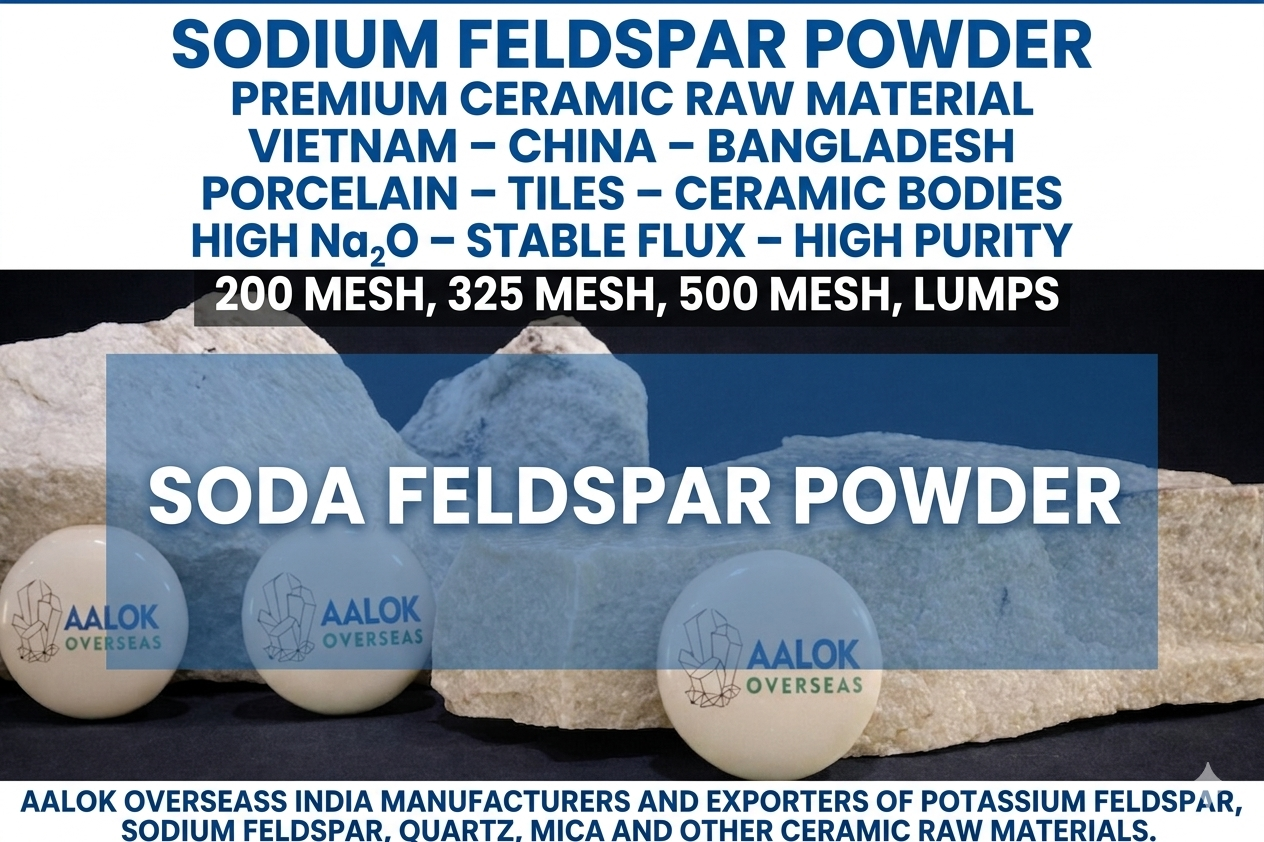
India Feldspar Export Market 2025:
Sodium Feldspar · Potassium Feldspar · Trade Data, Trends & Country Analysis
A comprehensive, data-driven analysis of India's feldspar export industry — covering export volumes, USD values, destination country port-level data, HS code classification, demand drivers, and the competitive position of Indian feldspar in the global ceramic raw material supply chain. Markets covered: Vietnam, Indonesia, Malaysia, Bangladesh, Sri Lanka, Turkey, UAE, Saudi Arabia, Qatar, and Oman.
India Feldspar Exports
USD (2023–24)
India Exports To
All Feldspar Types
Exporter Rank
Gujarat, India
India's Feldspar Industry — The World's Ceramic Raw Material Engine
India is the world's second-largest feldspar producer and exporter, behind only Turkey in global export volume. The Indian feldspar belt — concentrated in Rajasthan (Ajmer, Bhilwara, Sirohi, Beawar), Gujarat, Andhra Pradesh, and Karnataka — produces an estimated 4.5–5 million metric tonnes annually, of which approximately 3.5 million tonnes are exported to ceramic, sanitaryware, glass, frit, glaze, and engineered stone manufacturers across Asia and the Middle East.
Indian feldspar exports have grown at a CAGR of approximately 8–10% over 2018–2024, driven by explosive growth in Vietnam and Indonesia's ceramic tile sectors, Bangladesh's emerging sanitaryware industry, and rising demand in the GCC construction market. The combination of geological quality, competitive production cost, and proximity to Asian markets gives Indian feldspar a structural advantage that no other origin can replicate.
Unlike Turkey — which produces primarily one feldspar type (mixed K-Na) from a few large quarries — India exports both distinctly high-K₂O Potassium Feldspar and distinctly high-Na₂O Sodium Feldspar (Albite), giving ceramic body formulators the ability to precisely target their alkali oxide ratios. This chemistry precision is India's greatest competitive advantage in the global feldspar market.
Ajmer–Bhilwara–Sirohi pegmatite zone produces the highest-quality K₂O and Na₂O feldspar in India. Beawar is the primary processing and export-packing hub. This belt supplies 60–65% of India's total feldspar exports.
Indian feldspar offers the widest chemistry range of any origin: K₂O from 9% to 12%, Na₂O from 7.5% to 11.5%, Fe₂O₃ from 0.06% to 0.20%. Buyers can spec to exact body formulation requirements rather than accepting a commodity grade.
India's feldspar processing industry includes hundreds of ball mills, hammer mills, and air classifiers producing 200 mesh through 600 mesh powder. Export packing in 25 kg, 50 kg, and FIBC jumbo bags (1000–1400 kg) is standard at all major Rajasthan plants.
Mundra Port (Gujarat) is the primary export point — 600 km from Beawar with direct shipping services to all major ASEAN, GCC, and South Asian ports. JNPT/Nhava Sheva (Mumbai) is the secondary port for Turkey and European routes.
HS Code 2508.10 — Feldspar Classification & Export Policy
All feldspar types — Potassium Feldspar (Orthoclase / Microcline), Sodium Feldspar (Albite), and mixed K-Na feldspars — are classified under a single HS heading in India's export tariff. Understanding this classification is essential for both exporters and importers claiming FTA preferential duty rates.
| HS Code | Description | Includes | India Export Duty | FTA Rate (ASEAN) |
|---|---|---|---|---|
| 2508.10 | Feldspar | Potash Feldspar · Soda Feldspar · Albite · Orthoclase · Microcline · All mesh sizes · Lumps | NIL (0%) | 0% (Form AI) |
| 2508.10.10 | Feldspar — Potash (sub-heading, some countries) | High-K₂O grades — Orthoclase, Microcline, Potassic Feldspar | NIL | 0% |
| 2508.10.20 | Feldspar — Soda / Sodium (sub-heading, some countries) | High-Na₂O grades — Albite, Sodium Feldspar, Soda Spar | NIL | 0% |
| 2505.10 / 2616.90 | Quartz / Silica Sand & Powder | Snow White Quartz · Silica Flour · Crystalline SiO₂ powder | NIL | 0% |
Export Policy Note: Feldspar (HS 2508.10) is a freely exportable commodity from India with zero export duty, no quantity restriction, and no export licence requirement as of 2024–25. Check current DGFT Foreign Trade Policy for any updates before contracting. India's feldspar export falls under Schedule 2 of ITC(HS) as a freely tradeable mineral.
India Feldspar Production & Export Volume — Historical Trend
The following data represents estimated production and export volumes based on Indian Bureau of Mines (IBM) reports, DGFT shipping bill data, and industry estimates. Figures are approximate and may vary by source. Feldspar export volumes have grown significantly driven by Asia-Pacific ceramic industry expansion.
| Year | Production (MT) | Export Volume (MT) | Export Value (USD M) | Avg. FOB Price (USD/MT) | YoY Growth |
|---|---|---|---|---|---|
| 2019–20 | 4,100,000 | 2,650,000 | ~$115M | ~$43 | Base year |
| 2020–21 | 3,800,000 | 2,320,000 | ~$98M | ~$42 | –12% (COVID) |
| 2021–22 | 4,400,000 | 2,900,000 | ~$135M | ~$47 | +25% (recovery) |
| 2022–23 | 4,700,000 | 3,150,000 | ~$155M | ~$49 | +8.6% |
| 2023–24 | 5,000,000 | 3,480,000 | ~$182M | ~$52 | +10.5% |
| 2024–25 (Est.) | 5,300,000 | 3,750,000 | ~$200M | ~$53 | +7.8% (est.) |
* Source: IBM Mineral Production Statistics, DGFT shipping bill aggregates, industry estimates. MT = Metric Tonnes. Figures are rounded estimates.
Export Split: Potassium Feldspar vs Sodium Feldspar (2023–24)
| Type | Est. Volume (MT) | Share of Total | Avg. FOB (USD/MT) | Primary Markets |
|---|---|---|---|---|
| Potassium Feldspar (K-Feldspar) | ~2,050,000 | ~59% | ~$54–58 | Vietnam · Indonesia · Turkey · Sri Lanka · Bangladesh |
| Sodium Feldspar / Albite (Na-Feldspar) | ~1,200,000 | ~34% | ~$48–52 | Vietnam · Malaysia · Bangladesh · GCC · Indonesia |
| Mixed / Unclassified Feldspar + Lumps | ~230,000 | ~7% | ~$38–42 | Bangladesh · Sri Lanka · Oman · Qatar |
Indian Ports for Feldspar Export — Port-Wise Volume & Routes
Feldspar export from India is concentrated through three primary ports. The choice of port depends on the production location (mainly Rajasthan), destination country, and available shipping line services. Mundra dominates because of its proximity to the Rajasthan mineral belt and its direct shipping services to all key Asian and Middle Eastern ports.
| Port | Location | Est. Share Feldspar Export | Primary Destinations | Transit Time |
|---|---|---|---|---|
| Mundra Port | Kutch, Gujarat (600 km from Beawar) |
~60–65% | Vietnam · Indonesia · Malaysia · UAE · Saudi Arabia · Qatar · Oman · Sri Lanka · Bangladesh | SE Asia: 10–16 days GCC: 8–10 days South Asia: 4–8 days |
| JNPT / Nhava Sheva | Navi Mumbai, Maharashtra |
~20–25% | Turkey · Bangladesh · Sri Lanka · Malaysia · Indonesia · GCC | Turkey: 18–22 days SE Asia: 12–18 days |
| Kandla / Deendayal | Kutch, Gujarat (near Mundra) |
~8–10% | Bangladesh · Sri Lanka · Oman · Qatar | South Asia: 4–8 days GCC: 8–12 days |
| Other Ports | Pipavav · Hazira · Cochin · Chennai |
~5–8% | Various — smaller volumes and niche routes | Varies by destination |
20 FCL: ~25–27 MT net (50 kg bags) or ~25 MT (FIBC jumbo bags). Most common for feldspar exports. 40 FCL: Used by large buyers for cost efficiency — approximately 25–27 MT for 25 kg bags due to weight limits, or 50+ MT in jumbo bags for light-density minerals.
MSC · CMA-CGM · COSCO · Hapag-Lloyd · Evergreen · Wan Hai · PIL (Pacific International Lines) — all operate direct or transshipment services from Mundra to Vietnam (HCMC/Hai Phong), Indonesia (Surabaya/Tanjung Priok), Malaysia (Port Klang/Tanjung Pelepas), and GCC ports.
Mundra–Vietnam: USD 250–450/20FCL. Mundra–Indonesia: USD 300–500/20FCL. Mundra–UAE/GCC: USD 180–320/20FCL. Mundra–Bangladesh: USD 80–180/20FCL. JNPT–Turkey: USD 800–1,400/20FCL. Rates fluctuate with global container market conditions.
Country-Wise India Feldspar Export Data — Volume, Value & Port Intelligence
The following country profiles present estimated annual feldspar import data from India, destination ports, types of feldspar preferred, and demand drivers. Figures are based on DGFT shipping bill data, port authority statistics, and industry estimates for 2023–24.
Feldspar Exports
Vietnam is India's single largest feldspar export destination, driven by one of Asia's fastest-growing ceramic tile and sanitaryware sectors. Bình Dương and Đồng Nai provinces north of Ho Chi Minh City are the production heartlands, importing primarily through Ho Chi Minh City port (Cát Lái terminal) and Hai Phong in the north.
tràng thạch kali · tràng thạch natri · nguyên liệu gốm sứ Ấn Độ
Feldspar Exports
Indonesia's ceramic industry, concentrated in East Java (Pasuruan, Sidoarjo) and West Java (Bekasi, Tangerang), imports Indian feldspar primarily through Tanjung Perak (Surabaya) for East Java plants and Tanjung Priok (Jakarta) for West Java. Volume has grown significantly as PT Surya Toto, American Standard Indonesia, and domestic tile producers expanded capacity.
feldspar kalium · feldspar natrium · bahan baku keramik Indonesia
Feldspar Exports
Bangladesh imports 100% of its feldspar from India — primarily under SAFTA preferential 0% duty. Chittagong (Chattogram) Port is the sole significant import gateway. The Gazipur–Narsingdi ceramic cluster is the primary consuming zone. Growth CAGR of 12–15% driven by RAK Ceramics Bangladesh, AKIJ Ceramics, and Shinepukur capacity expansion.
পটাশ ফেল্ডস্পার · সোডা ফেল্ডস্পার · SAFTA শুল্কমুক্ত ভারত
Feldspar Exports
Malaysia imports Indian feldspar primarily through Port Klang (West Malaysia) and Tanjung Pelepas. The Ipoh (Perak) ceramic cluster and Shah Alam (Selangor) frit/glaze manufacturers are major consumers. Malaysia also re-exports some processed ceramic products using Indian mineral inputs to ASEAN neighbours.
feldspar kalium · serbuk kuarsa putih · bahan mentah seramik Malaysia
Feldspar Exports
Sri Lanka imports high-spec Indian feldspar for EU-export-grade sanitaryware and porcelain tableware production in its Ekala–Ja-Ela Free Trade Zone corridor. All feldspar arrives through Colombo Port — one of the world's busiest transshipment hubs. Under ISFTA, Indian feldspar qualifies for preferential duty rates.
පොටෑෂ් ෆෙල්ඩ්ස්පාර් · ඉන්දියාව ISFTA · Ekala Ja-Ela ceramic zone
Feldspar Exports
Turkey imports Indian feldspar to supplement its domestic supply, particularly for ultra-low-iron premium grades that Turkish domestic mines cannot consistently produce. Indian K-feldspar with K₂O ≥ 10.5% and Fe₂O₃ ≤ 0.07% is used by Kütahya manufacturers for EU-export-grade sanitaryware. Ships through JNPT primarily, arriving at Mersin, Ambarlı (İstanbul), or İzmir ports.
potas feldispat Hindistan · sodyum feldispat ihracatçısı · Kütahya seramik hammaddesi
Feldspar Exports
GCC imports Indian feldspar for RAK Ceramics (UAE), Saudi Ceramics (Riyadh, Jeddah), Qatar Ceramics (Doha), and Omani tile producers. Jebel Ali (Dubai) is the dominant UAE import port and also serves as the re-export hub to Saudi Arabia and other GCC states. Under India–UAE CEPA, feldspar exports to UAE enjoy phased duty elimination.
فلسبار البوتاس الهند · الفلسبار الصودي · مواد السيراميك الخليج
Summary — Country-Wise Export Overview 2023–24
| Country | Est. MT/Year | USD Value | Share | Key Import Port | FTA Duty |
|---|---|---|---|---|---|
| 🇻🇳 Vietnam | ~900,000 | ~$48M | ~25% | Cát Lái (HCMC) · Hai Phong | 0% AIFTA |
| 🇮🇩 Indonesia | ~720,000 | ~$38M | ~21% | Tanjung Perak (Surabaya) · Tanjung Priok (Jakarta) | 0% AIFTA |
| 🇧🇩 Bangladesh | ~480,000 | ~$22M | ~14% | Chittagong (Chattogram) | 0% SAFTA |
| 🇹🇷 Turkey | ~320,000 | ~$19M | ~9% | Mersin · Ambarlı (İstanbul) | MFN rate |
| 🇦🇪 GCC (UAE+KSA+QAT+OMN) | ~290,000 | ~$16M | ~8% | Jebel Ali · Jeddah · Hamad · Sohar | 0% UAE (CEPA) |
| 🇲🇾 Malaysia | ~280,000 | ~$15M | ~8% | Port Klang · Tanjung Pelepas | 0% AIFTA |
| 🇱🇰 Sri Lanka | ~210,000 | ~$12M | ~6% | Colombo Port | ISFTA / SAFTA |
Key Trends Driving India Feldspar Export Growth 2025
Vietnam's ceramic tile capacity expanded by approximately 25% between 2020 and 2024, with new plants in Bình Dương, Đồng Nai, and Thái Bình. Every new tile plant line of 1M sq.m/year capacity requires approximately 800–1,200 MT of feldspar annually. New FDI investments from Japanese, Taiwanese, and Korean ceramic groups are accelerating this growth.
Bangladesh has no domestic feldspar production — 100% is imported from India. With SAFTA 0% duty and 5–8 day transit, no other origin can compete on landed cost. Bangladesh's ceramic capacity has tripled since 2015 and is still growing. This is India's most captive export market for feldspar.
Across all markets, ceramic manufacturers are upgrading from standard to premium body specifications — driven by EU export standard requirements, rising consumer expectations, and competition from China's premium segment. This translates to higher specification feldspar (K₂O ≥ 10.5%, Fe₂O₃ ≤ 0.07%) replacing commodity grades — and higher FOB values for Indian exporters.
Saudi Arabia's NEOM, Qatar post-World Cup infrastructure, UAE 2040 Plan, and Oman's diversification programme are collectively adding USD 1T+ in construction projects. Every square metre of tiles, every washbasin, and every WC in these projects requires feldspar as the primary raw material. GCC is India's fastest-growing feldspar export region by value growth.
Shift to high-pressure casting (HPC) technology in sanitaryware requires modified body formulations with lower plasticity and more precise feldspar chemistry. HPC requires tighter Na₂O + K₂O consistency (±0.3% batch-to-batch) — driving demand toward XRF-verified, dedicated-mine-sourced Indian feldspar over commodity blended grades.
India's AIFTA membership gives Indian feldspar 0% duty access to Vietnam, Indonesia, Malaysia, and 7 other ASEAN markets. Turkey — India's main competitor — has no FTA with ASEAN and faces 5–15% MFN duty in these markets. This structural cost advantage of USD 2–8/MT is a permanent feature of the Indian supply chain that no processing advantage can overcome.
Potassium Feldspar vs Sodium Feldspar — Why Both Are Essential
| Parameter | Potassium Feldspar (K-Spar) | Sodium Feldspar (Na-Spar / Albite) |
|---|---|---|
| Mineral Name | Orthoclase / Microcline | Albite |
| Key Alkali Oxide | K₂O ≥ 10–11% | Na₂O ≥ 9.5–11% |
| Melting/Fusion Range | 1150–1250°C | 1100–1150°C (Lower) |
| Glass Phase Behaviour | Viscous, stable melt | More fluid melt, faster |
| Best Applications | Sanitaryware · Porcelain tableware · Fine ceramics · Insulators | Fast-fire tiles · Glazes · Frits · Glass |
| India FOB Price (2024) | USD 54–62/MT | USD 48–54/MT |
| India Export Volume Share | ~59% | ~34% |
|
Search Recent Posts
 Raise your Query Hi! Simply click below and type your query. Our experts will reply you very soon. WhatsApp Us
|

Leave a Comment